Thinking about a West Coast coffee tour? Here’s your guide.

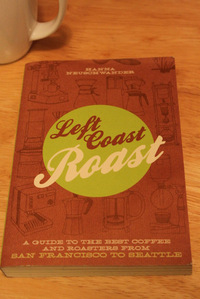
If you want to experience the best coffee the West Coast has to offer, but aren’t sure where to start, check out Left Coast Roast: A Guide to the Best Coffee And Roasters from San Francisco to Seattle, by Hanna Neuschwander. The book profiles fifty-five coffee roasters in Washington, Oregon and California and contains a coffee education section packed with tips about how to navigate specialty coffee.

Neuschwander sat down with me to talk coffee and tell her story. Her eyes flickered with enthusiasm as she recounted her research.

Originally from Spokane, Washington, Neuschwander moved to the other Washington (D.C.) when she was eight years old. She returned to the Pacific Northwest in 2006, following a six-month road trip around North America that doubled as a search for a new home. When she arrived in Portland, Neuschwander was working as a freelance editor for a non-profit publisher, but tired of being alone at home all day, she soon found a job as a barista at Extracto, a then-new micro-roaster on Northeast Killingsworth Avenue.

“It was just the right environment for me to learn about coffee. I didn’t know anything about it at that point,” Neuschwander recalled. “It’s a family business, and I very much felt like I was part of that family.”

When Neuschwander left Extracto for her current position as director of communications for the graduate school of education and counseling at Lewis and Clark College, she did not want to leave coffee completely, so she started writing about it.

“Writing about coffee became a way for me to stay connected to both the community and also the world of ideas about coffee,” she said. Neuschwander’s articles have appeared in several publications, including Barista, Roast, Willamette Week and MIX Magazine. When Timber Press approached her to write a guide to coffee roasters on the West Coast, Neuschwander took the opportunity. After negotiating the structure and layout with the Portland-based publisher, she spent six months researching and writing the book.

Her travels increased her enthusiasm for coffee and brought some of the differences between cities into focus. There is not just one “West Coast” style in coffee.

“One thing that Seattle continues to do well that San Francisco and Portland don’t do that well is that it’s an espresso town. Espresso Vivace is a perfect example of this,” explained Neuschwander. “David Schomer has spent thirty years perfecting one flavor profile and just doing it right. It’s amazing—they have the most loyal customer base of any coffee company I have ever seen. It’s insane. There’s lines out the door every single morning.”

Neuschwander would not say who had the best coffee, although she did mention several Portland roasters when I asked her about it.

“People ask me all the time what’s my favorite place,” she said. “I’m not being disingenuous when I say I don’t have a favorite. What’s exciting to me is the fact that you can go to Spella  and get a traditional Italian espresso served on a lever machine, and they’ve got affogato. And you can go to the Stumptown Annex and pick from one of thirty pretty amazing single-origins. You can go to Heart and they’re going to have some crazy single-origin espressos. That’s what exciting.”

Neuschwander still marvels at the speed at which the specialty coffee industry is growing.

“I was in San Francisco a couple weeks ago, and over the course of the two days I was there, seven new roasters in Oakland started up. The roasters are very small, but things are happening. There’s something kind of special that’s still happening on the West Coast that’s different than the East Coast.”

Left Coast Roast takes some of the mystery—but not the mystique—out of specialty coffee. With friendly prose and an abundance of illustrations, Neuschwander gently and clearly educates her readers on sourcing, roasting, brewing and, of course,  searching out better coffee. She successfully makes the beverage more accessible to both the average coffee drinker and to those who want a deeper understanding of “that little marvel in your cup.”


[Side note: Hanna and I met for our conversation at Cascade Barrel House, a brewery in Southeast Portland famous for its lambic (sour) beers. A few minutes into the interview, Cascade’s owner rang a bell to get everyone’s attention. He announced he was going to break into a new barrel, which called for a celebration. The brew master for this particular barrel had the honor of pounding the tap into the barrel with a large wooden mallet, similar to the kind you might see at a carnival’s high striker (test of strength).

Being a taste aficionado but not much of a beer drinker, it was interesting to hear the owner talk about his product. He boasted of the new ale’s  “creamy bitterness, candied marzipan and maraschino cherry” flavors that were “off the charts.” The similarity to coffee was apparent, and I couldn’t help but think that, like coffee people, beer people are excited about what they’re doing.]
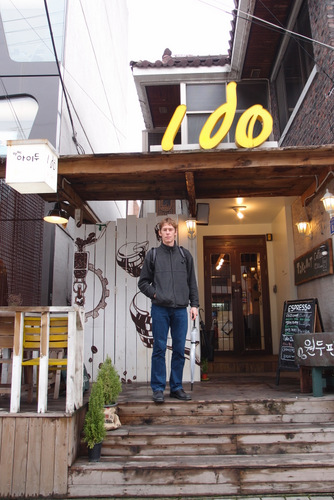
Café I Do (Hongdae, Seoul)

[This is another in a series of articles about Seoul and its coffee scene. The trip took place in early November, and I’m posting my recollections as I finish them.]

Squeezed in between a mobile phone store and a small office building, it would be easy to walk past Café I Do without even noticing the café. The oversight would be your loss, however, because the café is one of the most inviting in Seoul.

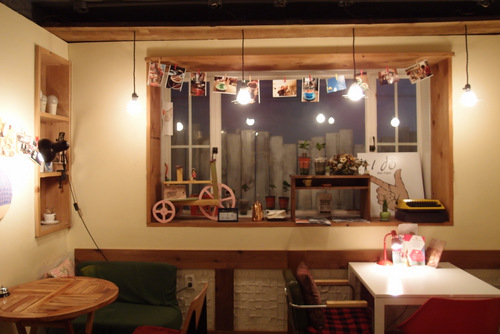
On a chilly November afternoon, Jinsu and I ambled up the old wooden porch at Café I Do, in Seoul’s Hongdae District. We stepped into the shop and took a look around. At the front of the café, a narrow passage separated the coffee bar on the left from the sample roaster on the right. The floorboards creaked with each step as we made our way to a small table in the back of the shop.

Cafe I Do. Photo courtesy JInsu Lee

“What do you think?” Jinsu asked, gesturing at the décor.

I looked around. The shop felt familiar, homey. Electric heaters rotated slowly back and forth, keeping frosty drafts from outside at bay and providing a welcome refuge for my cold hands and tired feet. An array of photos and knickknacks were spread throughout the café. It was the type of place that might remind you of sitting in your grandmother’s kitchen while sipping cocoa and eating popcorn as snow falls outside.

“I like it,” I replied. “It’s so….cozy.”

Photo courtesy JInsu Lee

Jackie Chang, a well-known competitor in Seoul’s barista competitions, founded the shop in 2010 with a couple of his friends. Chang was not at the shop the afternoon we were there, but one of his co-founders (and head barista), who goes by the name of Spike, was.

Spike sat down with us to tell us his own coffee story, a story that begins far from Seoul. Spike studied hotel management in Switzerland, and as part of his education, he worked at a hotel in Italy, where his co-workers introduced him to espresso.

“When I got a cold,” he explained, “my Italian friends gave me coffee. ‘Drink this, you’ll feel better,’ they said.”

Leaving Italy, Spike returned to Korea to fulfill his mandatory two-year Korean military service requirement. When that was finished, he was ready for something new.

“I didn’t want to learn more hotel management. I wanted to find something that I really wanted to do,” he said.

He tried several different jobs, eventually ending up as a barista in another café. Coffee soon caught his attention.

“I got the passion six months later,” he said.

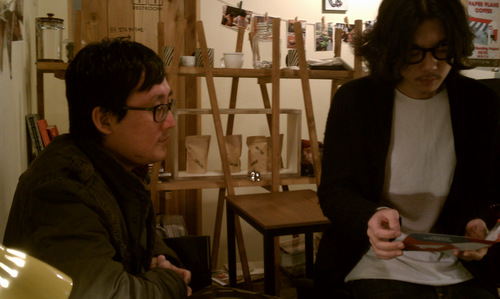
Jinsu and Spike, talking coffee

Spike liked that he had more influence over the quality of coffee, compared to wine.

“With wine, I could choose certain ones for people. This one’s better than that one, or this one goes with that meal. But with coffee, I could actually make different tastes and aromas for customers. That’s really interesting for me. That’s why I want to make coffee and be a barista.”

Spike credited Chang, for fueling his desire to learn more about coffee.

“Our owner, Jackie Chang, taught me how to taste espresso,” said Spike. “He’s a real barista. He just loves coffee. He’s not in it for the money.”

Spike was confident that Café I Do could stand out in Seoul’s crowded coffee industry.

“All our customers know we’re different,” he said. “They know that at the chains, the employees have no skills as baristas. They go to those places because the coffee is really cheap. When they want something that tastes different, they go to a smaller shop. Our customers know that.”

Getting customers excited about the coffee is a big step for growing the specialty coffee scene. Seoul’s coffee drinkers display an curiosity about coffee that bodes well for the future of the specialty industry.

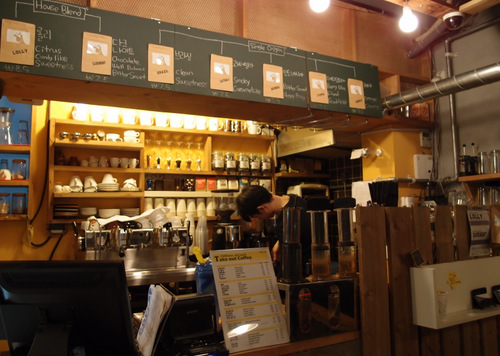
“Every day we have to change the beans in the blends because the beans change every year,” he said. “All the customers ask me, ‘today’s blend, what’s in it?’ They really like to talk about it with the barista.” Where the magic happens. Photo courtesy Jinsu Lee

Café I Do has two different blends, one for straight shots and one for milk drinks. The shop does not serve single-origin espresso shots, though they do offer several single-origin drip coffees. The café’s AeroPress bar indulges customers who want to emphasize the brightness in the coffees.

“These days, Korean customers and baristas really like acidity in their coffee,” Spike said.

My espresso was sweet and light-bodied, well-balanced with a strong chocolate aftertaste. Jinsu enjoyed his mocha, though he would have preferred dark chocolate. Knowing we had further coffee stops ahead, we held off trying the AeroPress coffee.

Café I Do is not as slick or polished as some shops, which is one of the reasons I liked it. Of all the cafés we visited in Seoul, it seemed like the one that would most likely be found in Southeast Portland. On a rainy day, Café I Do would be an ideal spot to hide with a novel or a notebook.

Vitals
Address: 1F, 410-10, Hapjeong-dong, Mapo-gu, Seoul, South Korea (map)
Subway stop: Hapjeong (Line 2 or 6), Exit 6, or Sangsu (Line 6), Exit 1
Hours: Monday-Sunday 12pm-12am
Wi-Fi? Yes
Recommendations? Bring poetry or your best friend
Website: cafeido.com

Case Study Downtown

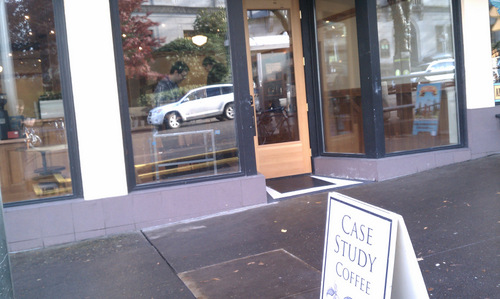
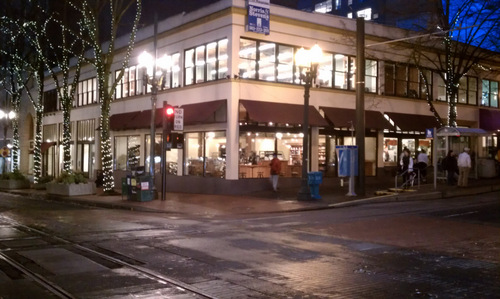
Early last week, I spent some time at Case Study’s new café, at Southwest 10th and Yamhill, across the street from the Central Library. My impression? As they say, “the rich get richer,” and Portlanders have yet another good café where residents can meet to enjoy quality coffee, right in the heart of downtown.

If you were to walk by the shop and just glance inside, you might think the new shop is a place to go for an after-work pint or two. The shop doesn’t sell anything stronger than espresso, but it has the ambience of an upscale tavern. This was intentional, according to Christine Herman-Russell, Case Study’s owner.

“The seating is a little more spread out in here,” she said. “It gives the café more of a public house feel and seems to encourage more conversation.”

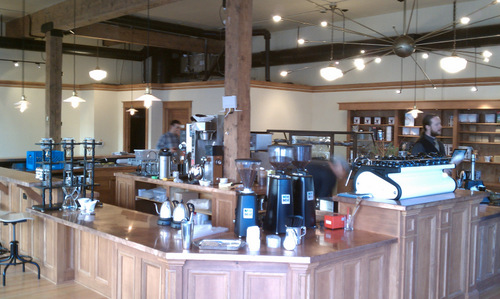
In the center of the café, a long, smooth copper bar invites you to sit for a drink. Vintage light fixtures hang low from the high ceilings, their swooping filaments enveloping the café in a warm, amber light. With large, floor-to-ceiling windows, the mood of the café varies with the weather, changing from bright and lively to dim and reserved as clouds pass by overhead. In the northeast corner of the shop, a vintage Probat roaster sits patiently, waiting to be fired up. Echoing the original café, one of the café’s most prominent features is the ‘exploding spider’ light fixture hovering over the espresso machine. Its copper color complements the coffee bar.

“This one is similar to the other Sputnik [what the baristas call the original fixture], but it’s a little more elegant,” said Ricky Sutton, the head of Case Study’s coffee program.

Bright and shiny

Unlike the Northeast Sandy shop, which still sells some Stumptown coffees, the downtown shop will serve exclusively Case Study coffee. Brewed coffee will be made with a Fetco brewer (once it is dialed in, according to Sutton) instead of a French press.

Open little more than a week, everything inside the café feels new—you can still smell a hint of sawdust and varnish mixed in with the coffee aroma. The shop’s large windows provide a unique vantage point from which you can observe Portland’s downtown pulse. From my table, I watched as torrential downpours sent Portlanders scurrying for cover, rushing to avoid a mid-day soaking. When the sun came out, people strolled more leisurely, enjoying autumn in the city.

The new café’s grand opening is slated for December 3rd. Until then, as Case Study employees get used to the new space and work out the kinks, the shop will be open from 7am-5pm every day. After the grand opening, the plan is to keep the shop open until 10pm, for the after-dinner coffee and dessert crowd.

All lit up at nightCase Study’s second shop is easily accessible without a car, sitting at the crossroads for both the street car and the MAX lines. If you can avoid the temptation to sit and watch Portlanders passing by the large windows, it would also be a good shop to sit and work.

With yet another quality shop to visit, is it fair to say that Portland has officially entered a ‘golden age’ of great coffee? I dare say so.

Vitals
Address: 802 SW 10th Ave (map)
Hours: Sunday-Saturday 7am-5pm
Coffee: Case Study
Wi-Fi? Yes
Recommendations? Grab a cup and sit at the window to watch Portland pass by
Website: http://casestudycoffee.com

Coffee Lab (Hongdae, Seoul)

As I mentioned in an earlier post, Seoul has an abundance of coffee shops. While there are cafés all over the city, if you are looking for quality coffee, you should head for the Hongdae area. The area has three different universities, with thousands of students who in need of lots of caffeine to stay focused during marathon study sessions. Bustling with young people, Hongdae is also famous for its nightlife and burgeoning arts scene.  New trends, like better specialty coffee, sprout up in this part of the city.

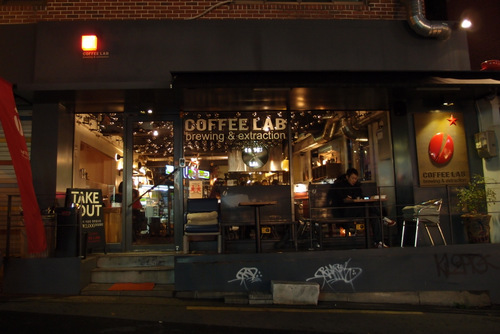
Our first stop in Hongdae was at Coffee Lab. Coffee Lab was founded in 2008 by Bang Jong Koo, the 2005 Korean barista champion. (In Seoul, it seems like every Korean barista champion has his or her own shop—a positive development for Koreans who want better coffee.)  

Coffee Lab. Photo courtesy Jinsu Lee

Read More

The Coffee Test (A cultural lesson on dating in Korea)

[Thanks to my friend, Ji-Yoon (Jade) Choi, another former Portlandian who moved back to Seoul, for telling me about this.]

One of the fun parts of traveling is that you get to learn about other cultures. Being in an unfamiliar place forces you to follow new patterns. If you are open-minded, you gain a better understanding of how other people see the world.

I learned several things that stretched my perspective while I was in Seoul (did I mention the lunch with squirming octopus chunks?). One interesting part of Korean culture I learned about is called the coffee test.

In Korea, coffee has become part of the dating ritual, at least among the younger generation. When young couples go out to dinner, they often follow up the meal with a trip to a café for coffee and/or dessert. When the pair goes out for the first time, this café visit can be a strong indicator of the future of the relationship.

Typically, the man pays for the couple’s dinner and the woman pays for the coffee. If the woman doesn’t like the man, however, she will make no move when it is time to pay for the coffee. When this happens, the man has failed the coffee test—he has the double misfortune of paying twice and of being rejected.

While this test is a rather indirect way of communicating lack of romantic interest, it is effective. Therefore, gentlemen, if you ever take a Korean woman out for coffee after dinner and she doesn’t pay the tab, you’re probably not the one she’s looking for.

You failed the coffee test.